
The Samson Project Series #7

To say I felt lost after Samson’s passing would be far too small a statement. I was not simply sad, tired, or discouraged. I was disoriented. My heart knew the mission had to continue, but knowing and feeling had become two different worlds. Intellectually, I understood the facts: communities were still depending on the boreholes, CFF still needed partnership, donors still deserved careful stewardship, and Samson’s dream still deserved to be carried forward. Emotionally, however, I felt emptied out. The conviction remained, but the strength behind it felt fractured. I could still explain why the work mattered, but I no longer felt the energy that had once made continuing seem natural.
Until then, I had struggled to understand people who lost their drive after tragedy. I had seen grief change people from the outside, and if I am honest, I had judged it too simply. I thought determination was mostly a matter of will. I thought if a purpose was strong enough, a person could keep moving no matter what happened. I had even promised myself I would never become someone who allowed pain to interrupt the work. Then grief found me, and I understood how arrogant that promise had been. Loss does not always destroy conviction; sometimes it drains the body and mind of the ability to act on that conviction. I still believed in the mission, but belief alone did not lift me out of bed, answer messages, make decisions, or carry responsibility with the steadiness I once had.
Depression is not a word I have historically been comfortable using, especially about myself. But looking back I have to admit that I was depressed. I was still committed in principle. I still answered messages, tried to make responsible decisions, and remained aware that people were counting on me. Yet the emotional strength that had carried me for years seemed to disappear almost overnight. I was moving, but I was not thriving. I was functioning, but only barely. If going through the motions was a person, it was me.
Not wasting personal pain means refusing to let difficult experiences harden into bitterness. Instead, it is about finding meaning in the struggle and allowing it to refine our perspective, deepen our empathy, and clarify purpose.
That season taught me, in a painfully practical way, why discipline matters more than motivation. Motivation depends on emotional fuel, and after losing Samson, that fuel was gone. Discipline became the narrow bridge between what I felt and what still had to be done. It did not make the grief lighter, and it did not make the work easy. It simply kept me from walking away. Some days, discipline meant answering one message. Other days, it meant making one call, reviewing one update, or choosing not to let silence become my response to responsibility. I was not moving forward with confidence. I was moving forward because love, duty, and promise would not let me stop completely.
The hardest part was realizing how unprepared I was. For years, the PFW board had emphasized the importance of helping our Nigerian partner organization develop a clear succession plan, just in case something happened. I understood the logic. I agreed with the need. I even intended to help make it happen. But intention, once again, was not the same as action. I delayed, assuming there would be more time, more conversations, more opportunities to formalize what everyone already seemed to know. Samson was so central to the work that I allowed his strength to become, in my mind, a kind of insurance policy. When he passed, I was not only devastated and depressed; I was exposed. I had to face the painful truth that my grief was compounded by a leadership failure. I had cared deeply about the mission, but I had not adequately prepared for the possibility of continuing without the person who held so much of it together.
Putting the Pieces Together
Thankfully, our partners at CFF were not as unprepared as I was. Even in their grief, Samson’s wife, Ann, who served as the organization’s co-chair, Gideon Kadon, Samson’s trusted right-hand man, and Abraham, Samson’s oldest son, were ready to continue. They were not untouched by the loss; no one who loved Samson could be. But they carried their grief with a kind of grace and resolve that steadied the rest of us. Where I felt disoriented, they began gathering the pieces. Where I worried the mission might fracture, they showed me that Samson had built more than projects. He had built people, habits, conviction, and a legacy strong enough to keep moving after him.

Once again, Samson impressed me in a way I had not expected. Even in death, his preparation spoke. The family and team he left behind did not pretend the loss was small, and they did not rush past their sorrow as if grief were an obstacle to productivity. They mourned deeply, as they should have. But beneath that mourning was a shared understanding that the vision could not stop because the visionary was gone. Samson had given so much of himself to this work that continuing it became one of the clearest ways to honor him. They knew his dream still had a future, and they understood that they were now among the people entrusted to carry it.
Watching the CFF team reassemble after tragedy was both inspiring and convicting. I had always liked the idea of turning setbacks into comebacks, but until then, the phrase had mostly lived in the safe distance of speeches, books, and encouragement offered to other people. This was different. This was personal. I had watched a team lose its central leader and still choose responsibility. I had watched family members carry public duty while privately grieving. I had watched people who had every reason to pause indefinitely decide instead to keep serving. Their resilience did not erase my sadness, but it disrupted my despair. If they could continue with such courage, then I had to ask whether my own grief was going to become a reason to retreat or a force that could be transformed into recommitment.
That question forced me to examine the things I had called essential. Tragedy has a way of stripping life down to what is real. Some commitments sound important when life is stable, but they cannot survive loss. Others become clearer precisely because loss exposes their weight. I began asking myself what I would still choose after heartbreak, what responsibilities would remain when motivation disappeared, and what promises were too sacred to abandon simply because carrying them had become painful. That season helped me let go of things I had treated as urgent but were not truly important, and it helped me embrace more deeply the responsibilities that would remain essential no matter what I endured.
Years earlier, a mentor had told me not to waste pain when it came. At the time, I understood the words only in theory. They sounded wise, but distant—something a person says after hardship has already been processed and shaped into testimony. After Samson’s death, I finally understood them in practice. Not wasting pain does not mean pretending grief is useful immediately or forcing suffering into a neat, inspirational lesson before the wound has even begun to close. It does not mean rushing past sadness, spiritualizing away loss, or acting as if heartbreak becomes meaningful simply because we say the right words about it. It means refusing to let pain have the final word. It means allowing sorrow, over time, to deepen empathy, clarify purpose, refine responsibility, and expose what kind of commitment is still alive when the emotions that once fueled it are gone. I watched the team Samson had built do exactly that. They turned their pain into movement. They let grief sharpen their commitment rather than silence it. Their resilience was more than inspiring; it was necessary. And if the CFF team could turn pain and adversity into constructive progress, then I had to ask the obvious question: why couldn’t I?
For me, transforming pain into progress was not straightforward. It did not happen in one brave decision or one emotional breakthrough. It happened slowly, unevenly, and often without much confidence. Some days, resilience looked nothing like strength. It looked like answering a message I wanted to ignore, opening a document I did not feel ready to read, or sitting with the ache long enough to make one responsible decision. Other days, it meant admitting I was not okay and allowing people who loved the mission to help carry what I could no longer carry alone. Regaining momentum meant revisiting the mission when I did not feel strong enough to carry it, leaning on people when I would rather have withdrawn, and staying open to the possibility that grief could coexist with purpose. True resilience, I learned, is not the absence of pain, fear, doubt, or exhaustion. It is the decision to keep moving toward meaning while still feeling vulnerable, uncertain, and fully aware of what has been lost.
Pain and failure are unavoidable, but whether they become teachers is not automatic. We have to choose to listen. We also have to choose what we will let pain produce in us. Left unattended, pain can narrow a person. It can make the heart suspicious, defensive, and smaller. But when pain is faced honestly—with enough humility to learn from it and enough courage to remain open—it can reveal what still matters, expose what was fragile, and point us toward a more faithful version of the work. Samson’s passing did all of that. It revealed the strength of the people he had formed, exposed the weaknesses in my own preparation, and forced me to decide whether the mission would remain only attached to my grief or become an expression of love, discipline, and continued responsibility. In time, that became the beginning of my own return—not to who I had been before, because grief had changed me, but to a steadier and more sober commitment to what still needed to be done. Resilience did not make me less aware of the loss. It made me more determined that the loss would not be the end of the story. If the work was going to honor Samson, it could not survive on emotion alone. It would have to become more consistent, more disciplined, and more durable than my grief. That realization became the bridge into the next season of the mission: not simply picking up the pieces but learning how to carry them forward faithfully over time.
A Foundation Strong Enough to Hold
By the time leadership responsibilities began shifting to the remaining CFF team, the mission was no longer held together by passion alone. It had begun to rest on a stronger operational foundation—one built through years of trial, correction, trust, and shared discipline. That mattered more than I fully understood at the time. In the early days, so much of the work depended on improvisation: figuring out how to move funds, how to document decisions, how to coordinate across distance, and how to keep projects moving despite uncertainty. We had learned many of those lessons the hard way. But by the time Samson passed, those lessons had become systems.One of the clearest examples was the way we moved funds into Nigeria. What had once required caution, workaround solutions, and more anxiety than I care to admit had become a far more stable process. Funds were now wired directly to CFF through established channels, with clearer documentation, better accountability, and a shared understanding of how the money would be received, distributed, tracked, and reported. That shift may sound administrative, but it represented something much deeper. It showed that the partnership had matured from personal trust into institutional trust.Samson had prepared his leadership team to carry that responsibility. He had taught them to receive funds carefully, distribute them appropriately, steward them transparently, and account for their use with seriousness. Because of that preparation, the work did not depend on one person holding every detail in his head. The process had become teachable, repeatable, and trusted. That was exactly the kind of foundation the mission needed if it was going to continue beyond him.In grief, I had feared that Samson’s absence would expose only fragility. Instead, it revealed something more complex and more hopeful. Yes, the loss was devastating. Yes, no one could replace him. But the systems, people, and values he had helped build were still standing. The mission had been wounded, but it had not collapsed. That realization did not erase my sadness, but it gave me something solid to stand on: Samson had not merely carried the work; he had helped build a structure capable of carrying it forward.
The First Project Without Samson
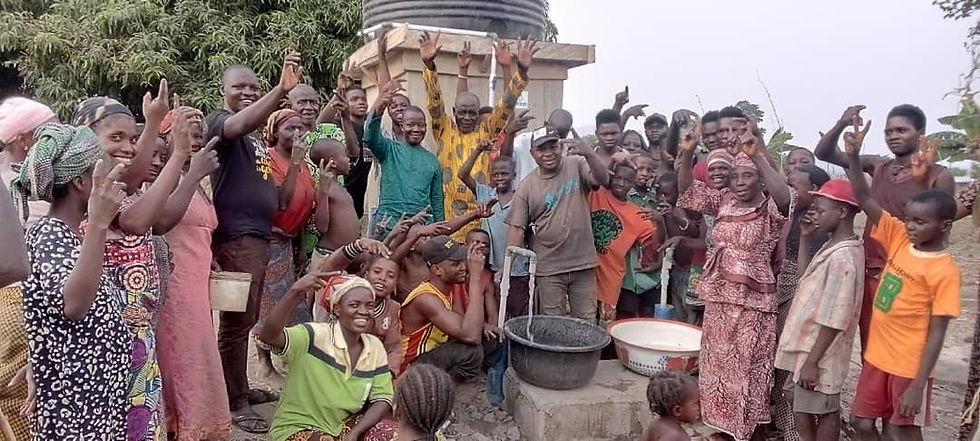
Because the team was ready to keep moving, we were able to complete the next water project—our 43rd—in December 2024, only four months after Samson’s passing. Operationally, the project demonstrated the strength of the structure that had been built. CFF could coordinate the work, communicate across the partnership, manage resources, engage the community, and see the project through to completion. In that sense, project 43 became evidence that the mission could continue.Emotionally, however, it was a very different kind of milestone. It was the first project completed without Samson. There was joy in knowing another community would receive clean water, but the joy carried grief inside it. Every update seemed to hold two truths at once: the work was still alive, and the person who had helped give it life was no longer here to see it. That tension made the project difficult in a way operations could not explain. Nothing had gone wrong with the construction, but everything about the moment felt different because Samson’s absence stood beside every sign of progress.Still, completing that project mattered. It reminded us that honoring Samson could not remain only a feeling or a memory. It had to become action. It had to show up in responsible decisions, careful stewardship, continued partnership, and the willingness to serve the next community even while grief was still fresh. Project 43 became more than another borehole on a list. It became the first proof that the mission could carry Samson’s legacy forward—not by pretending we were not grieving, but by allowing love, discipline, and responsibility to keep the work moving.
Driving On
After project 43, the work slowly began to feel different. The grief did not disappear, but it no longer stood at the center of every project in the same way. We completed four more projects in 2025, and by 2026 we were on pace to complete five additional projects. Each new borehole carried its own importance: another community gaining reliable access to clean water, another set of families relieved from the daily burden of scarcity, another reminder that the mission was still alive. At each completion, I still felt Samson’s absence.
There were moments during celebrations, updates, photographs, or community reports when I instinctively thought of him and felt the ache of knowing he was not physically there to witness what his vision was still producing. But alongside that ache, something else began to grow: gratitude, steadiness, and even joy. The accomplishments no longer felt like evidence that we were moving on from Samson. They felt like evidence that we were moving forward with him—carrying his values, honoring his leadership, and extending the dream he had helped place in motion.Every project completed after his passing added another layer to his legacy.
It was not only that clean and sustainable water had reached another community, though that would have been enough reason to rejoice. It was also that the work itself had become a living tribute. As long as the mission continues, Samson’s influence continues. As long as communities are served, his love for his people is still bearing fruit. And as long as his legacy lives on in action, then in a meaningful way, so does he.That realization changed how I understood the work ahead. The question was no longer simply whether we could survive the loss of Samson and complete another project. Project 43 had answered that. The deeper question became whether we could continue with consistency, humility, and faithfulness over time.
Could we keep serving communities without allowing grief to harden into hesitation? Could we keep making careful decisions, maintaining completed boreholes, supporting CFF, and honoring the standards Samson had helped establish? Could the mission grow without losing the spirit that gave it life?In time, each completed project became part of that answer. The work did not return to what it had been before Samson’s passing, because grief had permanently changed the landscape. But it did find a new rhythm. It became quieter in some ways and more disciplined in others. We were no longer proving only that clean water could transform a village. We were proving that a mission rooted in friendship, trust, and shared responsibility could endure loss and still remain faithful to its purpose.That is why the next milestone mattered so deeply.
Reaching fifty completed water projects would not be only a numerical achievement or a reason to celebrate organizational growth. It would become a marker of endurance: proof that the systems we had built could hold, that the people Samson had prepared could lead, that donors and communities could continue trusting the work, and that grief could be transformed into steady, life-giving action. Project 50 would not erase the pain of Samson’s absence. But it would show that his dream had not stopped at his death. It had continued moving through every community served, every borehole maintained, every partner who stayed committed, and every person who chose to keep carrying the mission forward.


Comments